Zijian "Jason" Ding, PhD
(he/him)
Postdoctoral Fellow
KAIST School of Computing
PhD in Human-Centered AI
University of Maryland College Park
Professional Summary
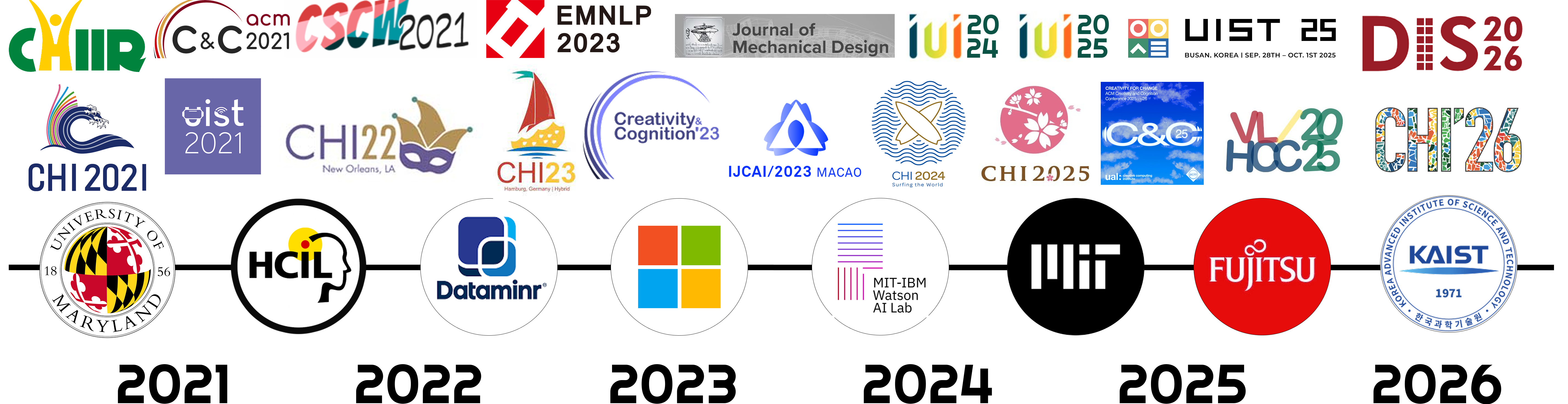
I am Jason Ding, a Postdoctoral Fellow at the KAIST School of Computing, working with Prof. Joseph Seering and Prof. Juho Kim. I received my PhD in Human-Centered AI from the University of Maryland, College Park (Jun 2026). My research aims to answer one central question: how can we design AI systems to understand, execute, and respond to human intents? To answer it, I developed the Research Framework: Five Levels of Intent, spanning closed-ended to open-ended tasks: intent as a label to classify (EMNLP'23); a hidden goal to infer and elicit (CHI'21, C&C'21, CHI'22, C&C'23, CHI'24); a reified, editable object (VL/HCC'25, UIST'25 poster, DIS'26, C&C'25); something negotiated in the human-AI dyad (CHI'25); and a collective object a community shapes (CHI'26, DIS'26, CSCW'21).
During my PhD, I’ve had the privilege of completing 4 research internships at Microsoft Research, MIT-IBM Watson AI Lab (IBM Research), Fujitsu Research of America, and Dataminr AI Org. My industry research has been published in AI/HCI conferences (EMNLP 2023, IUI 2025 demo, C&C 2025), and made real-world impacts such as first-authored GenAI patents (IBM Research published; Fujitsu Research of America in filing) and GenAI products (Microsoft Copilot, Dataminr ReGenAI).
I have been fortunate to be advised by a remarkable lineage of mentors — my PhD advisor Prof. Joel Chan (UMD), master’s advisor Prof. Steven Dow (UCSD), Prof. Stephen MacNeil (UCSD), Prof. Xiaojuan Ma (HKUST), and Prof. Helen Meng (CUHK) — whose guidance continues to shape how I think about research. Paying this lineage forward, I now mentor students from UIUC, Cornell, UC San Diego, and Imperial College London on projects at the intersection of HCI and AI, and serve as an Associate Chair for ACM CHI 2027 and Publications Chair for ACM Creativity & Cognition (C&C) 2026. Even earlier, I completed my undergraduate studies in Electronic and Information Engineering at the Hong Kong Polytechnic University on a full scholarship (HK$480,000).
Education
PhD in Information Studies
2020-08-01
University of Maryland, College Park
MS in Information Science
2018-09-01
2020-06-30
University of California, San Diego
BEng in Electronic & Information Engineering
2014-02-01
2018-06-30
The Hong Kong Polytechnic University
Interests
Experience




News
| Aug 2026 | Serving as an Associate Chair (AC) for ACM CHI 2027 |
| Jul 2026 | I will join the KAIST School of Computing as a Postdoctoral Fellow this fall, working with Prof. Joseph Seering and Prof. Juho Kim! 🎉 |
| Jul 2026 | My first-authored US patent application from IBM Research, "Automatic Generation and Visualization of Analysis Paths" (US 2026/0197255 A1), has been published With Dr. Michelle Brachman and Dr. Werner Geyer; related to our C&C 2025 paper and IUI 2025 demo |
| Jun 2026 | Successfully defended my PhD dissertation at the University of Maryland! 🎉 Huge thanks to my advisor Prof. Joel Chan and my committee — Prof. Eun Kyoung Choe, Prof. Leo Zhicheng Liu, Prof. Hal Daumé III, Prof. Yiwei Xu, and Prof. Fumeng Yang |
| May 2026 | "Toward Considerate Human-Robot Coexistence" accepted to RO-MAN 2026 Congrats to Yuanchen Bai, Prof. Angelique Taylor, and the Cornell Tech team  |
| Apr 2026 | Congrats to my mentees for their PhD admissions! Ziyi Wang → TAMU CS, Qinshi Zhang → FSU CS, Yixin Bai → UVA DS |
| Mar 2026 | "SpatialBalancing" accepted to DIS 2026 Congrats to Kexue Fu, Prof. Ray LC, Prof. Qinyuan Lei, and the CityU team  |
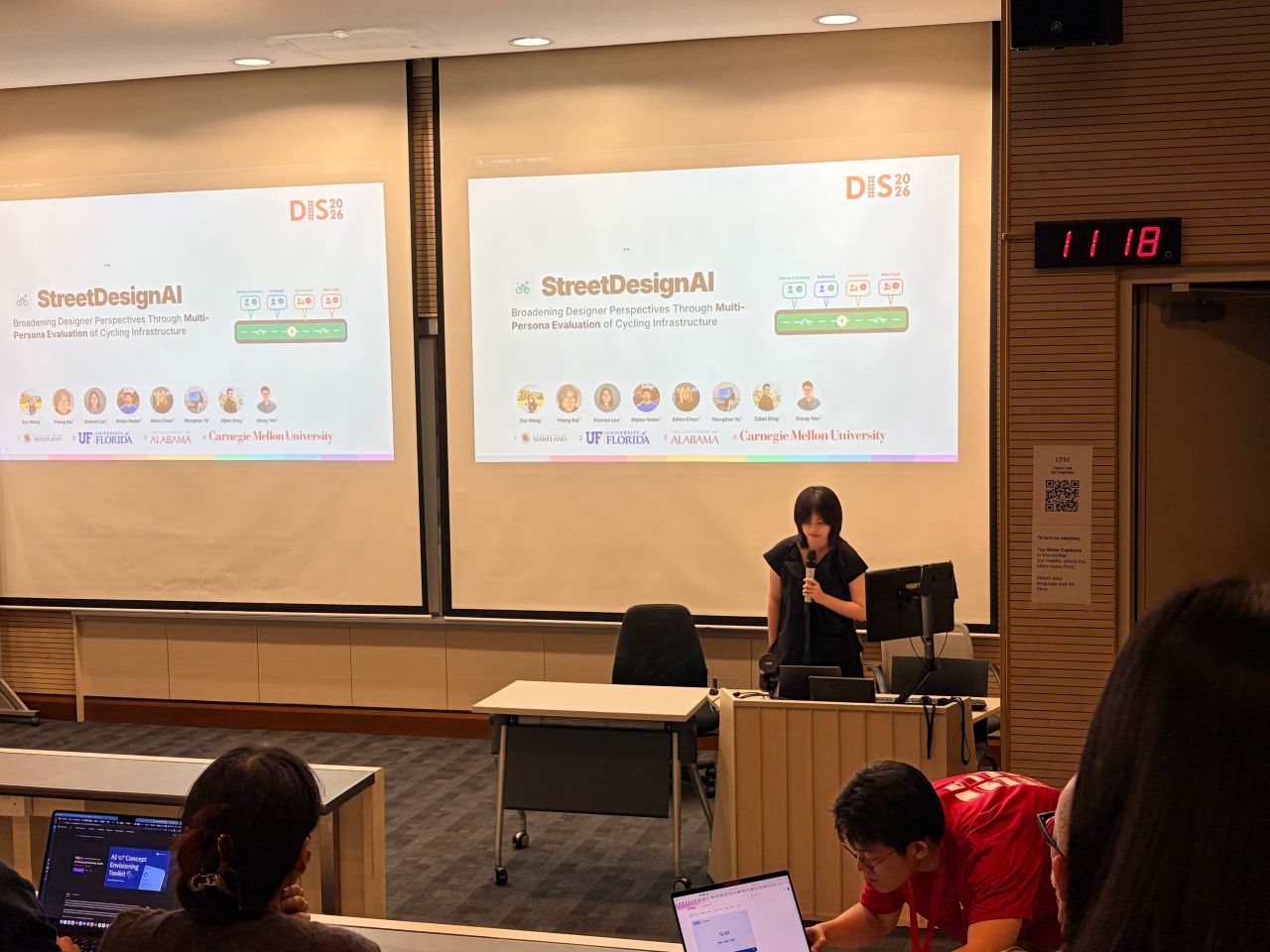
| Mar 2026 | "StreetDesignAI" accepted to DIS 2026 Congrats to Ziyi Wang, Prof. Xiang Yan, and the University of Florida team  |
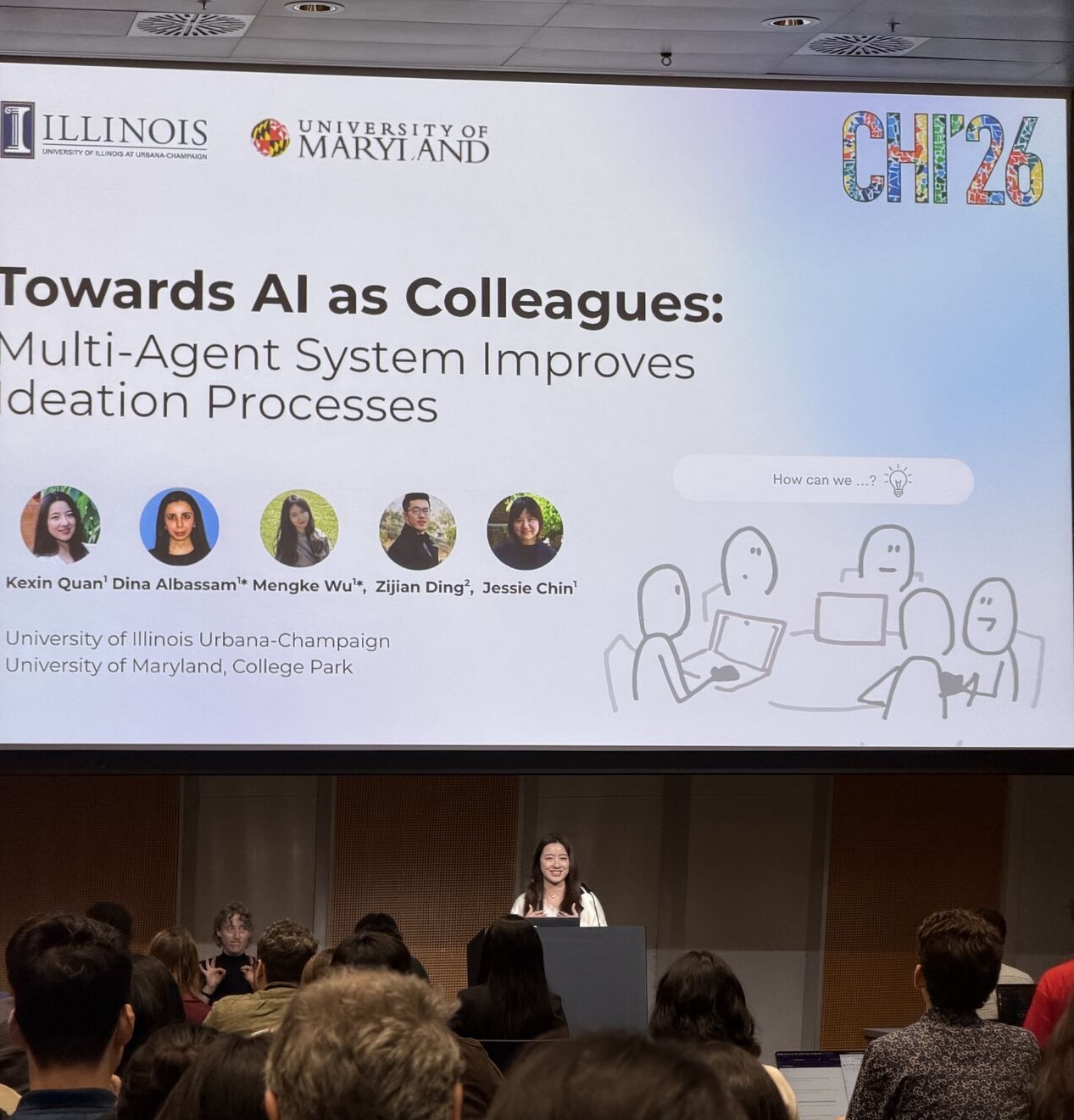
| Jan 2026 | "Towards AI as Colleagues" conditionally accepted to CHI 2026 Congrats to Kexin Quan, Prof. Jessie Chin, and the UIUC team  |
| Sep 2025 | Serving as Publication Chair for C&C 2026 |
| Aug 2025 | "Towards Direct Intent Manipulation" accepted to UIST 2025 poster |
| Jul 2025 | "Frontend Diffusion" accepted to VL/HCC 2025 |
| Mar 2025 | "The Diagram is like Guardrails" accepted to C&C 2025 |
| Jan 2025 | "Can AI Prompt Humans?" accepted to CHI 2025; "The Diagram is like Guardrails" accepted to IUI 2025 demo |
| Sep 2024 | Post-Candidacy Doctoral Student Research Award ($1,500) |
| Feb 2024 | ACM IUI Student Grant ($1,460) from NSF |
| Jan 2024 | Thesis proposal accepted to IUI 2024 Doctoral Consortium |
| Jan 2024 | "Formulating or Fixating" accepted to CHI 2024 |
| Nov 2023 | JMD paper featured in ASME Journal of Mechanical Design |
| Oct 2023 | "Harnessing the power of LLMs" accepted to EMNLP 2023 |
| Sep 2023 | Doctoral Student Research Award ($1,500) |
| Jun 2023 | Dean's Fellowship ($2,500) |
| May 2023 | Best Paper Honorable Mention at C&C 2023 |
| Apr 2023 | Two papers (Fluid Transformers, Freeform Templates) accepted to C&C 2023 |
Awards & Honors
| 2024 | Post-Candidacy Doctoral Student Research Award ($1,500) |
| 2024 | IBM PhD Fellowship nominee |
| 2024 | Apple Scholars in AI/ML PhD Fellowship nominee (3 university-wide) |
| 2024 | Google PhD Fellowship nominee (4 university-wide) |
| 2024 | ACM IUI Student Grant ($1,460, NSF) |
| 2023 | Pre-Candidacy Doctoral Student Research Award ($1,500) |
| 2023 | Dean's Fellowship, UMD College of Information ($2,500) |
| 2023 | Best Paper Honorable Mention — ACM C&C 2023 |
| 2021 | Dean's Fellowship, UMD College of Information ($10,000) |
| 2014 | PolyU Entry Scholarship — Academic Excellence (HK$480,000) |
Talks
| Apr 2026 | Invited Talk, Fujitsu Research of America |
| Feb 2026 | Guest Lecture, hosted by Prof. Yiwei Xu; C&C 2025 paper "The Diagram is like Guardrails" selected as required reading for the course |
| Dec 2025 | Invited Talk, Microsoft Research |
| Oct 2025 | Invited Talk, hosted by Prof. Qiao Jin, North Carolina State University |
| Oct 2025 | Invited Talk, hosted by Prof. Fumeng Yang, University of Maryland |
| Jul 2025 | Invited Talk, hosted by Dr. Yuexing Hao, Cornell University |
| Nov 2024 | Invited Talk, HCIL BBL (University of Maryland) |
| Aug 2024 | Invited Talk, MIT-IBM Watson AI Lab |
| May 2024 | Invited Talk, hosted by Prof. Steven Dow, University of California, San Diego |
| Mar 2024 | Invited Talk, hosted by Prof. Stephen MacNeil, Temple University |
Gallery
Research Framework: Five Levels of Intent
To answer how we can design AI systems to understand, execute, and respond to human intents, I developed this framework, ordered by how much intent must be surfaced and shaped: as tasks move from closed-ended to open-ended, intent becomes 1) a label to classify; 2) a hidden goal to infer; 3) a structured object users can edit; 4) something co-constructed in dialogue; 5) a collective object a community shapes. Each level builds on the ones below it.
Students
I am fortunate to work with these talented and motivated students. Underlined authors in the publication list indicate my students and myself. 📸 View photo gallery

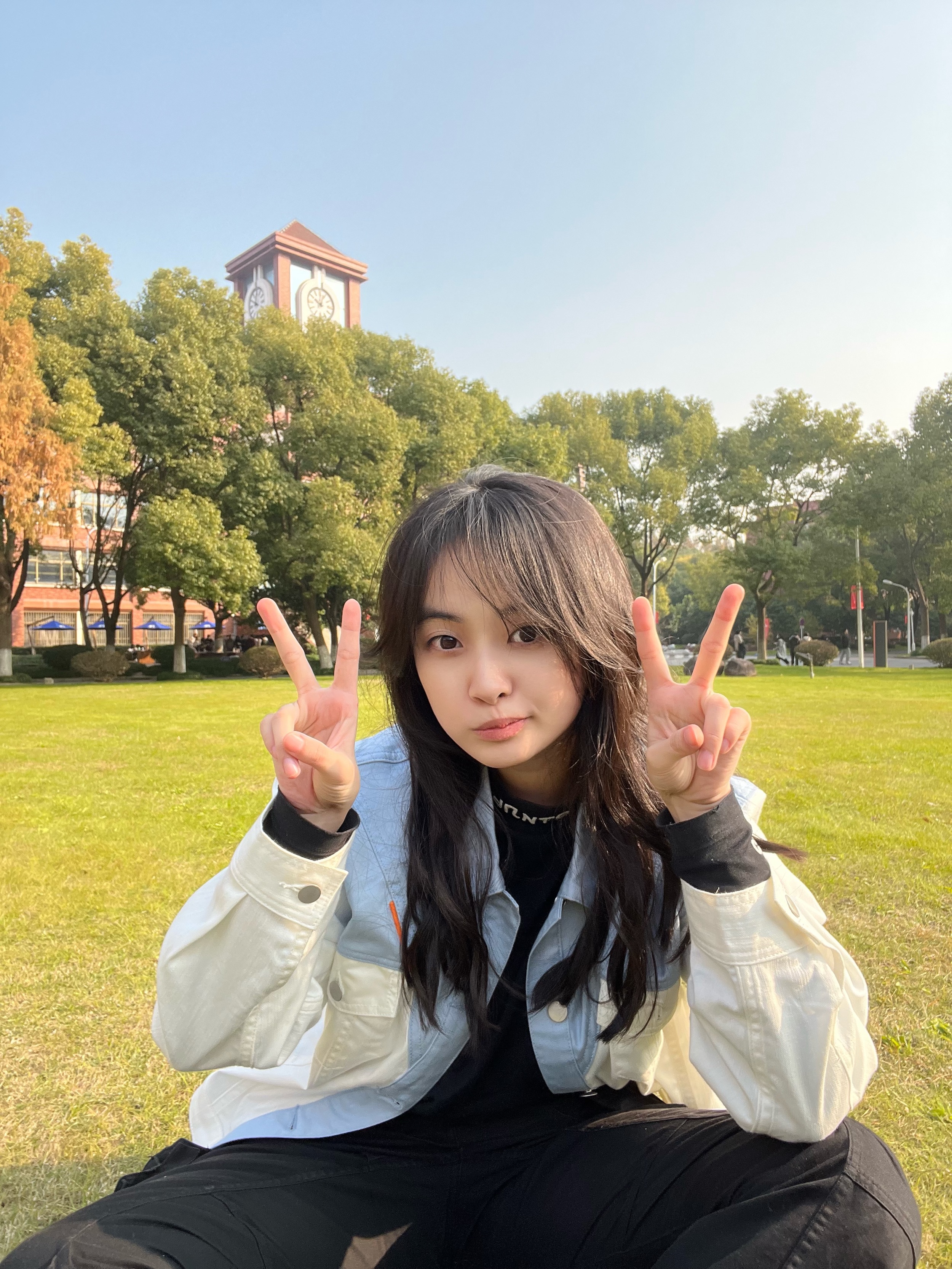
PhD Student, TAMU
PhD Student, Florida State
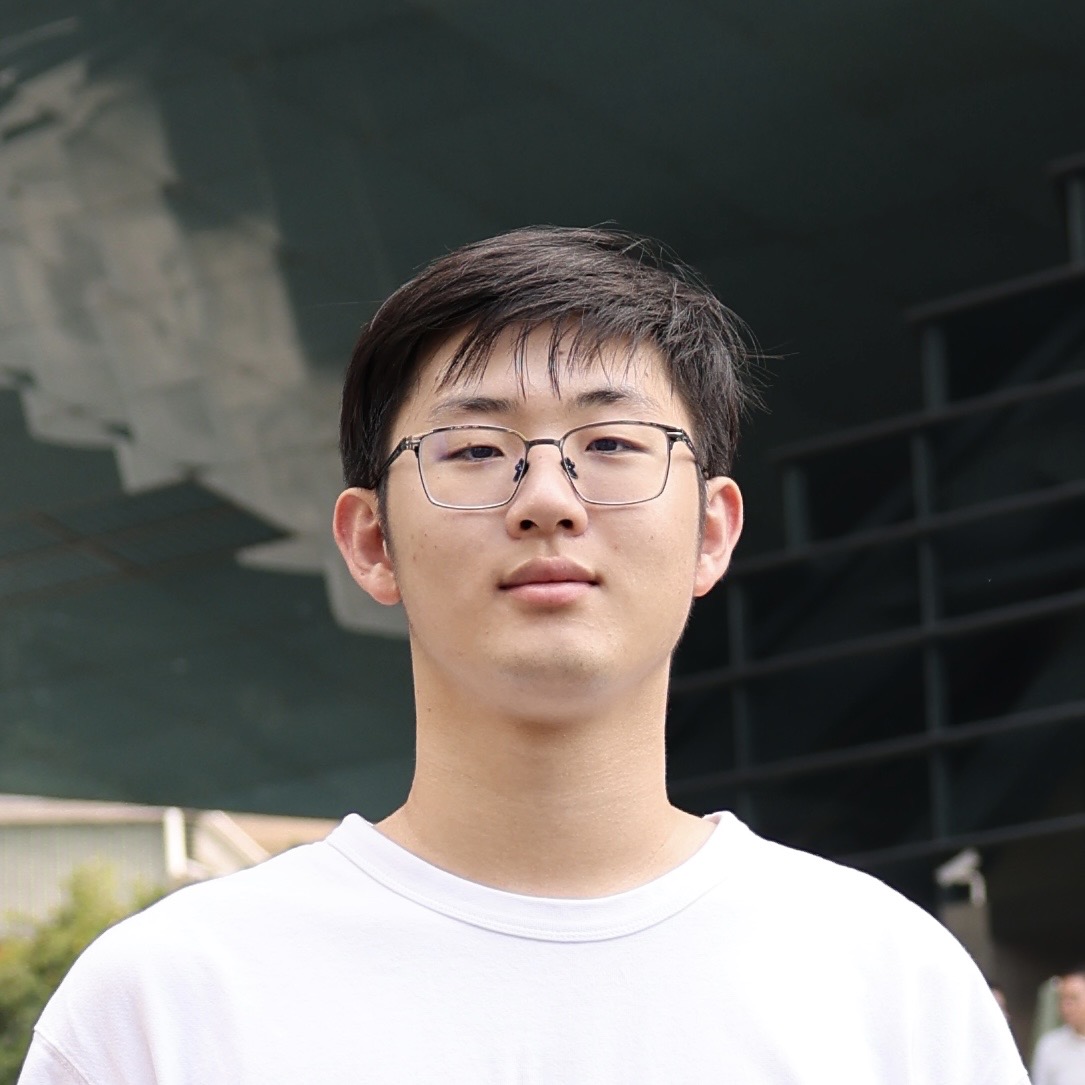
Stanford RA
Selected Publications
In HCI and AI research, full papers at top-tier conferences (e.g., CHI) are the primary scholarly contribution — equivalent to journal publications in other fields. These venues employ rigorous double-blind review with 20~25% acceptance rates, and proceedings are fully archival. * co-advisor; ** corresponding author.